
156
Planning a successful event involves managing countless moving parts. Organizers routinely focus on securing high-profile speakers, booking premier venues, curating catering menus, and executing targeted marketing campaigns. However, no aspect of event management carries greater weight than ensuring the physical safety and psychological well-being of attendees, staff, and performers.
Event security is far more than an operational checkbox or a visible presence at the entrance. It is a comprehensive framework that protects lives, preserves asset integrity, and safeguards the reputation of host organizations. Whether managing a intimate corporate conference, a multi-day music festival, a competitive sporting match, or a high-profile political rally, implementing a robust security protocol is foundational to modern gathering spaces.
Risk Assessment and Pre-Event Planning
Effective event security begins long before the first attendee steps through the venue gates. Comprehensive pre-event planning hinges on a thorough risk assessment designed to identify potential vulnerabilities and establish preemptive mitigation strategies. Every venue, demographic, and event type carries a unique threat profile that security teams must evaluate systematically.
Initial threat matrix evaluations analyze multiple variables to build a tailored security blueprint:
-
Venue Topography and Layout: Assessing entry and exit points, perimeter vulnerabilities, blind spots, emergency egress corridors, and physical structural constraints.
-
Attendee Profile and Capacity: Evaluating expected attendance numbers, VIP requirements, crowd demographics, and potential political or social friction points surrounding the event subject matter.
-
Local Threat Environment: Coordinate with regional law enforcement, fire departments, and emergency medical service providers to review crime statistics, active threat trends, and local municipal compliance ordinances.
-
Weather and Environmental Hazards: Formulating contingency plans for extreme heat, severe storms, structural fatigue, or forced venue evacuations.
A well-structured security plan outlines clear chains of command, defined communication channels, and specific operational duties for personnel across every shift. By anticipating worst-case scenarios, event organizers move from reactive crisis management to proactive risk prevention.
Crowd Management and Flow Control
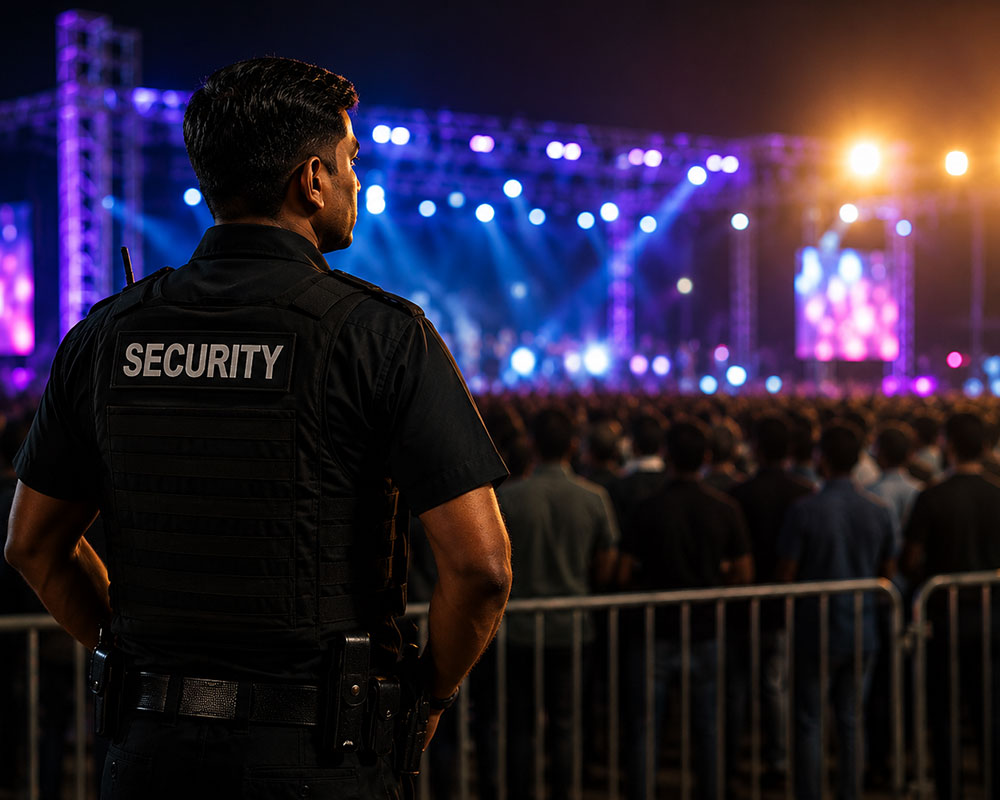
Large gatherings naturally create high-density environments where panic, confusion, or poor physical layout can lead to disastrous outcomes, including overcrowding, surging, and stampedes. Proper crowd management relies on strategic spatial planning and active monitoring to maintain smooth, predictable pedestrian movement throughout the duration of the event.
Security personnel use proven architectural principles and structural barriers to shape crowd behavior without disrupting the guest experience:
-
Staggered Entry Lines: Implementing serpentine queuing ropes, metal detectors, and credential scanning lanes to prevent bottlenecks at primary entrance points.
-
Zoned Perimeter Segmentation: Dividing large venues into smaller, manageable zones using barricades to monitor capacity levels in real time and prevent overcrowding near main stages or central attractions.
-
Clear Egress Pathways: Maintaining unobstructed aisles, marked fire exits, and dedicated corridors reserved strictly for emergency response vehicles and medical teams.
-
Directional Signage and Public Address: Utilizing elevated, high-visibility signage along with audible directions to guide foot traffic naturally toward exits, restrooms, and concession areas.
Trained security guards observe crowd dynamics to spot early indicators of tension or congestion. Early intervention, such as redirecting foot traffic or opening auxiliary egress gates, prevents minor density issues from escalating into hazardous situation.
Access Control and Perimeter Protection
Securing the boundary of an event is fundamental to preventing unauthorized entry and restricting prohibited items. Modern access control measures rely on a layered defense approach, creating multiple checkpoints that an individual must pass through before gaining access to core venue spaces.
The outermost security perimeter serves as the first line of defense. Security teams establish physical fencing, vehicle barriers, and screening stations far enough from the main venue entrances to mitigate threats before they approach densely populated areas.
-
Credential Verification: Employing color-coded wristbands, tamper-evident badges, digital tickets with anti-counterfeit barcodes, or radio frequency identification passes to restrict access based on tier level.
-
Physical Screening Protocols: Utilizing walk-through metal detectors, hand-held wands, bag inspections, and automated baggage scanning systems to interdict weapons, alcohol, illicit substances, and dangerous goods.
-
Zone Restrictions: Establishing restricted backstage, performer, and administrative areas secured by dedicated personnel who verify credential clearances continuously.
-
Parking and Vehicle Mitigation: Deploying bollards, security barricades, and vehicle search checkpoints to neutralize unauthorized vehicular access near pedestrian walkways.
A robust access control system ensures that only authorized individuals holding valid credentials enter the premises, significantly lowering internal security risks.
Emergency Response and Crisis Mitigation
Even the most meticulously planned events can face unexpected emergencies, ranging from medical crises and severe weather incidents to active threats or structural equipment failures. The true measure of an event security strategy lies in how effectively personnel respond when an unforeseen crisis occurs.
An actionable incident response plan relies on rapid communication and coordinated action across multiple departments. Security managers set up an onsite Incident Command Center equipped with dedicated radio networks, closed-circuit television monitoring, and direct phone links to local police and medical dispatchers.
Key elements of an effective crisis response strategy include:
-
Trained Onsite First Responders: Positioning certified emergency medical technicians and security staff equipped with automated external defibrillators and basic trauma kits strategically throughout the venue.
-
Standardized Evacuation Routes: Pre-determining multiple evacuation pathways and ensuring all staff members know how to direct guests toward safety calmly and efficiently.
-
Crisis Communication Protocols: Establishing clear internal relay systems to report incidents instantly without inciting widespread panic among attendees.
-
Unified Law Enforcement Coordination: Integrating public police officers, fire marshals, and private security teams into a single operational framework with aligned protocols.
When emergencies arise, clear leadership and pre-practiced response protocols drastically reduce response times, minimizing injury risks and preventing chaos.
Technological Integration in Modern Event Security
The landscape of event security has evolved significantly through technological integration. While human guards remain indispensable for physical intervention and guest service, advanced security technologies amplify situational awareness across expansive venues.
Modern security infrastructures leverage sophisticated hardware and software tools to streamline threat detection and resource management:
-
High-Definition CCTV and Analytics: Deploying high-resolution security cameras equipped with real-time video analytics to detect unusual crowd density spikes, abandoned bags, or restricted boundary breaches automatically.
-
Radio Frequency Identification Systems: Tracking staff movement and attendee access in real time to monitor venue capacity limits and prevent credential sharing.
-
Drone Surveillance: Utilizing aerial surveillance drones to monitor large-scale outdoor festivals, parking zones, and distant perimeters that are difficult to cover on foot.
-
Mobile Incident Reporting Apps: Equipping security staff with mobile devices running dedicated communications software to log incident reports, share geo-tagged images, and request assistance instantly.
By pairing advanced digital surveillance tools with trained security personnel, organizers maintain complete visibility across every square foot of the venue.
Safeguarding Brand Reputation and Liability
Beyond protecting physical safety, professional security safeguards the host organization against financial liability and long-term brand damage. An incident occurring at a public gathering can result in costly legal battles, insurance claims, regulatory fines, and permanent reputational harm.
Insurance underwriters frequently require detailed event security plans before issuing coverage policies. Demonstrating that an event employs licensed security professionals, follows local fire and safety codes, and maintains detailed incident logs satisfies regulatory compliance standards and lowers insurance premiums.
Furthermore, guests remember how an event made them feel. When attendees see well-organized security personnel, clear entry checkpoints, and attentive staff, they feel valued and safe. That sense of safety translates directly into positive brand perception, encouraging repeat attendance and fostering trust in future event initiatives.
Frequently Asked Questions
What ratio of security personnel to guests is recommended for public events?
Standard industry guidelines often suggest one security guard for every seventy-five to one hundred guests. However, this ratio varies based on event type, venue layout, alcohol service, guest demographics, and local regulatory requirements.
How far in advance should event security planning begin?
Security planning should begin during the initial stages of event organization, ideally three to six months prior to the event date. Large-scale public gatherings or major festivals may require security planning to commence a full year in advance to coordinate with city officials.
What is the primary difference between crowd control and crowd management?
Crowd management involves proactive planning, design features, and structural setups to guide and organize pedestrian flow smoothly. Crowd control refers to reactive measures taken by security personnel to handle disruptive behavior, panics, or overcrowding after an issue has developed.
Are private event security guards legally allowed to detain individuals?
Private security guards generally operate under citizen detention laws, meaning they can hold individuals suspected of serious crimes or active threats until local law enforcement arrives. Their primary responsibility is protection, de-escalation, and notifying law enforcement rather than police action.
How does alcohol service impact event security protocols?
Serving alcohol increases security risks by lowering guest inhibitions and heightening the potential for conflicts. Events featuring alcohol require increased security staffing near bars, mandatory age verification checks, and trained staff capable of identifying intoxication and de-escalating arguments.
What qualifications should event planners look for when hiring a private security vendor?
Event planners should ensure security vendors hold state licenses, carry comprehensive liability insurance, and provide background-checked personnel. Vendors must also offer specialized training in crowd management, conflict de-escalation, first aid, and emergency evacuation procedures.
How can security screening be conducted without causing massive entrance delays?
Delays can be minimized by utilizing high-throughput screening technologies like walk-through metal detectors, implementing clear bag policies in advance, setting up dedicated lines for guests without bags, and properly staffing entry gates during peak arrival times.
