
190
Many amateur magicians make the mistake of assuming that performing for children is easier than entertaining adults. The logic seems straightforward at first glance. Children are younger, less experienced with the physical laws of the world, and full of wonder. Surely, an audience that still believes in fantasy should be simple to impress with basic illusions.
The Fundamental Psychology of Young Audiences
To understand why children magic shows require a specialized skill set, one must first analyze how children experience live performance compared to adults. Adults attend a magic show with an implicit social contract. They agree to sit quietly in their seats, applaud at appropriate moments, and engage in a subtle game of suspension of disbelief. Even when an adult sees through a trick, social politeness usually prevents them from shouting out the solution or disrupting the performance.
Children operate without these social filters. They do not adhere to formal theater etiquette, and their reactions are immediate, uncensored, and highly vocal. If a child feels bored, they will look away, talk to their neighbor, or simply walk away from the performance area. If they spot a hidden trapdoor or a secret compartment, they will yell it out at the top of their lungs for the entire room to hear.
-
Immediate Gratification: Children process information in real time and expect continuous engagement without long narrative setups or complex mathematical card counting.
-
Filterless Communication: Young audiences do not polite-applaud. Their emotional state is completely transparent, giving the performer instantaneous feedback on what is working and what is failing.
-
Sensory Overload Thresholds: A room packed with excited children can quickly spiral into chaos if the energy level is not directed with intent and structure.
Moving from Sleight of Hand to Character and Comedy
Adult magic relies heavily on intellectual puzzles and sleight of hand. A magician performing for a room of adults might spend five minutes executing intricate card sleights or performing a sophisticated mentalism routine that requires deep concentration. The goal in adult magic is often to create a sense of impossible wonder that leaves the audience asking how the trick was accomplished.
For children, the puzzle itself is secondary to the fun of the experience. Children do not care about the technical difficulty of a pass, a palm, or a double lift. In fact, complex sleight of hand often fails with young children because they may not yet understand the baseline reality that the trick is attempting to break. If a magician vanishes a coin for a four-year-old, the child might simply assume the coin went away because coins can do that.
-
The Magician in Trouble Trope: One of the most effective techniques in children magic is making the magician look foolish or incompetent. When the magic goes wrong for the performer and the children have to help fix it, the dynamic shifts from passive watching to active participation.
-
Exaggerated Physicality: Broad gestures, animated facial expressions, vocal variety, and slapstick reactions resonate far more with young minds than calm, mysterious storytelling.
-
Visual and Prop-Based Effects: Large, brightly colored props that move, change color, or make funny noises hold attention much better than subtle close-up magic involving ordinary items like rubber bands or playing cards.
Master Level Crowd Management and Boundary Setting
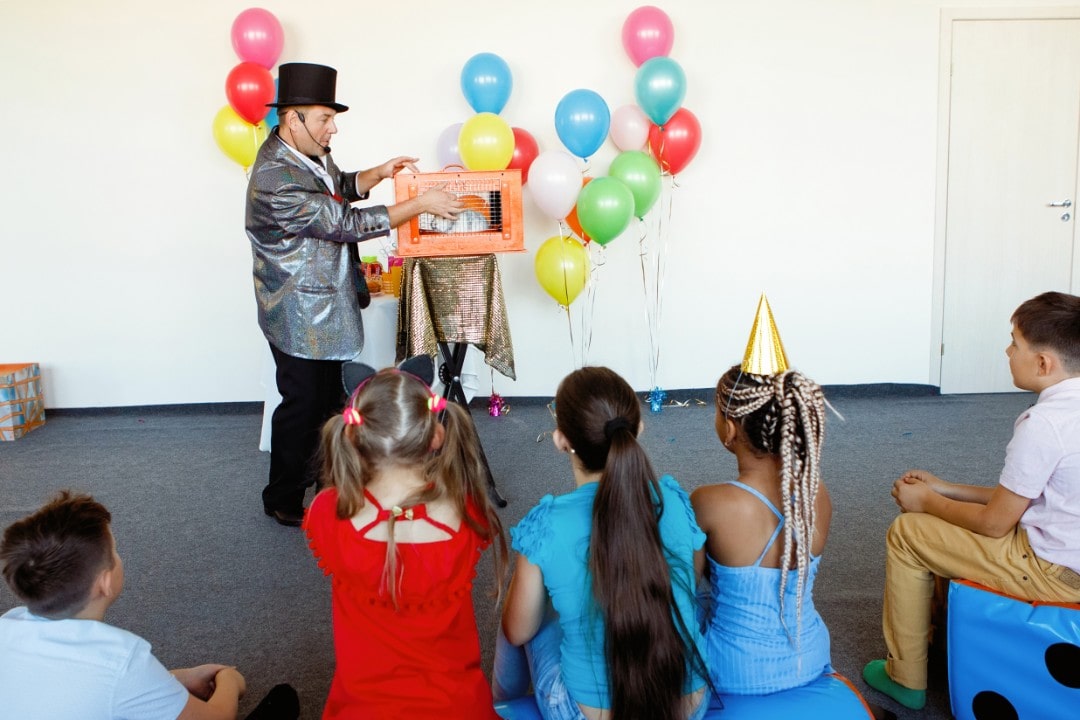
Performing magic for fifty seven-year-olds at a birthday party is as much an exercise in classroom management as it is in theatrical performance. A performer must possess exceptional situational awareness to keep a group of excited children safe, focused, and entertained without ever dropping character or resorting to harsh discipline.
When an adult show experiences a distraction, the performer can usually ignore it or use a clever line to regain control. In a children show, a single overly enthusiastic child running onto the stage can trigger a domino effect that sends half the room rushing forward to grab the magic props.
-
Establishing Non-Verbal Cues: Experienced children entertainers use rhythmic clapping, call-and-response vocal patterns, or sound effects to capture attention instantly without yelling over the noise.
-
Managing Spatial Boundaries: Setting up clear physical parameters before the show starts, such as a colorful performance mat or tape lines, helps define where the stage ends and the audience area begins.
-
Channeling Physical Energy: Rather than expecting children to sit perfectly still for an hour, successful shows incorporate opportunities for jumping, shouting, waving arms, and physical movement into the narrative of the tricks.
Handling the “I Know How You Did That” Factor
Every children magician inevitably encounters the young skeptic who is determined to prove that the magic is fake. Unlike adult hecklers, who are often cynical or malicious, child hecklers usually act out of excitement and a desire to demonstrate their own intelligence to their peers and parents.
A magician who responds to a child with defensive arguments or cold dismissal will instantly sour the atmosphere of the room. The skill lies in transforming the interruption into a moment of collective hilarity while gently redirecting the focus back to the fun of the trick.
-
Agreed Playfulness: Instead of arguing when a child shouts that a secret bag has a hidden pocket, the performer might pretend to inspect their own elbow or shoes, deliberately misunderstanding the child in a funny, playful way.
-
Validation and Pivot: Acknowledging the child keen observation skills builds rapport while immediately pivoting to a new, surprising turn in the routine that catches everyone off guard.
-
Empowering the Audience: Turning the audience into the heroes who make the magic happen prevents an us-versus-them dynamic between the magician and the kids.
The Art of Audience Participation
While adult magic shows feature occasional volunteers, children magic shows rely on constant, active participation. Every child in the room wants to feel like they are part of the spectacle. Choosing the right volunteer and guiding them through a routine requires high-level empathy and quick thinking.
A performer must instantly assess a child personality within seconds of them stepping onto the performance area. Is the child shy and in need of gentle encouragement? Are they eager to hog the spotlight? Are they prone to stage fright once everyone starts looking at them?
-
Protecting the Volunteer: The performer must ensure that the volunteer always looks great and never becomes the punchline of a joke. The goal is to make the child feel like a genuine wizard.
-
Keeping the Room Engaged: While interacting with a single volunteer, the magician must keep the rest of the audience involved through group magic words, collective gestures, and shared responses.
-
Adapting to Unpredictability: Children on stage will say and do completely unexpected things. A great performer treats these spontaneous moments as golden comedic opportunities rather than mistakes.
Frequently Asked Questions
What is the ideal age group for a specialized children magic show?
The sweet spot for a dedicated children magic show is typically between the ages of four and ten. Children in this range have developed the cognitive ability to follow basic narratives and understand cause-and-effect relationships while remaining fully open to imaginative play and visual wonder.
How long should a typical magic performance for children last?
A standard performance for young children should run between forty-five minutes and one hour. Pushing a show beyond sixty minutes often leads to diminished attention spans and physical restlessness, regardless of how engaging the performer is.
Why do classic card tricks usually fail in shows for younger kids?
Classic card tricks rely on numerical recognition, suit awareness, complex memory retention, and abstract spatial logic that young children are still developing. Additionally, playing cards lack the scale, color, and physical humor needed to keep a large group of kids visually engaged.
How do performers handle shy children who get nervous on stage?
Experienced performers never force a nervous child to stay on stage. They offer low-pressure roles, allow the child to bring a friend along, or gently let the child return to their seat with a round of applause while picking a more eager volunteer.
Can a magician perform the same show for toddlers and pre-teens?
No, performing the same routine for toddlers and pre-teens rarely works. Toddlers require simple visual effects, repetitive physical humor, and gentle music, whereas pre-teens prefer cooler, more sophisticated illusions, mentalism, and witty banter that respects their growing independence.
What equipment or staging adaptations are needed for birthday party magic?
Performers adapting to residential living rooms or backyard setups need self-contained, portable sound systems, lightweight backdrops to conceal hidden props, and durable, high-visibility props that can withstand close-up inspection from curious eyes.
Is it necessary for a kids magician to wear a traditional costume?
A traditional top hat and cape are no longer required and can sometimes feel outdated or intimidating to younger children. Modern performers often wear bright, approachable attire or themed costumes that match the tone of their character while remaining visually engaging.
